How to deliver a sustainable event
Contents
- Introduction
- How to use this guide
- What is a sustainable event?
- Planning your event
- Designing your event
- Delivering your event
- Reviewing, reporting and improvements
- Standards and frameworks
- Case study
- References, resources and further support
- Acknowledgements
- How AI was used
1. Introduction
Events in the post-16 education sector take many forms: large externally facing conferences, sector gatherings, research symposia, student summits, graduation ceremonies, open days and exhibitions. Creative disciplines may involve showcases, installations and end-of-year shows with significant physical materials and temporary builds.
Events are central to how institutions operate. They bring people together to share knowledge, build partnerships, celebrate achievement and engage with communities and are highly visible expressions of institutional values.
Events can generate significant environmental and social impacts. Travel, particularly by air, is typically the largest source of emissions. Events also generate waste, drive consumption, and place pressure on staff and participants. But sustainable events are not simply about reducing harm. Done well, they demonstrate leadership, model good practice, improve accessibility and inclusion, support local economies, and make institutional sustainability commitments tangible.
A core principle underpinning this guide is that every decision involves trade-offs. Choosing a fully in-person format supports networking and community, but increases emissions. Virtual and hybrid models widen access and reduce footprint, but may reduce engagement or create different barriers. Decisions about cost, venue, materials and sponsorship involve competing priorities at every turn. This guide does not resolve those tensions with simple answers. It helps institutions make informed, transparent decisions. Being clear about what choices are being made, and why, is often as important as the outcomes themselves.
EAUC's approach
At EAUC, we recognise that our own events need to reflect the principles we advocate across the sector. We are in a leadership position and do not take that lightly. Our events are opportunities to challenge ourselves, test new approaches and showcase what good practice can look like in real settings.
Our approach has developed over time as our understanding, evidence and expectations have evolved. We aim to consider sustainability broadly, including environmental impact, accessibility, equity, inclusion, wellbeing, procurement, travel, resource use and the experience of everyone involved.
We do not get everything right every time. Events are complex, practical constraints are real, and things can go wrong despite careful plannfing. What matters is that we are transparent about the choices we make, honest about the trade-offs involved, and committed to learning from each event so that we can keep improving.
We work with a wide range of people to deliver our events, including members, venues, suppliers, speakers, partners, staff and participants. Their insight and feedback are central to making events more sustainable, inclusive and effective. We welcome ideas, challenge and constructive feedback, and see sustainable event practice as a shared and continually evolving process.
We also recognise that events create value beyond formal content: they build confidence, connection, shared purpose and the professional and social support needed to sustain change across the sector.
“EAUC helps create and stimulate a community that is supported socially and psychologically as well as professionally. Shared purpose, resources and ideas make our college and university sector stronger, ready for positive change, and able to showcase its role in the future of our economy and society.”
John Thorne, sustainability coordinator at the Glasgow School of Art and sector reviewer
Continue to: How to use this guide
Or jump to: Introduction | How to use this guide | What is a sustainable event? | Planning your event | Designing your event | Acknowledgements | More resources | Back to contents
2. How to use this guide
This guide is written for anyone organising events in the post-16 education sector, whether you are a specialist event manager, an academic, a professional services member of staff, or a student. It covers events of all sizes, from large conferences to workshops, exhibitions and end-of-year shows.
Many institutions already have events teams, event management processes or sustainability policies that apply to conferences and events. This guide is not intended to replace those arrangements. Instead, it aims to support existing practice and help institutions embed sustainability principles consistently across all events, regardless of who is organising them. Over time, the goal should be for sustainable approaches to become standard practice rather than exceptional activity.
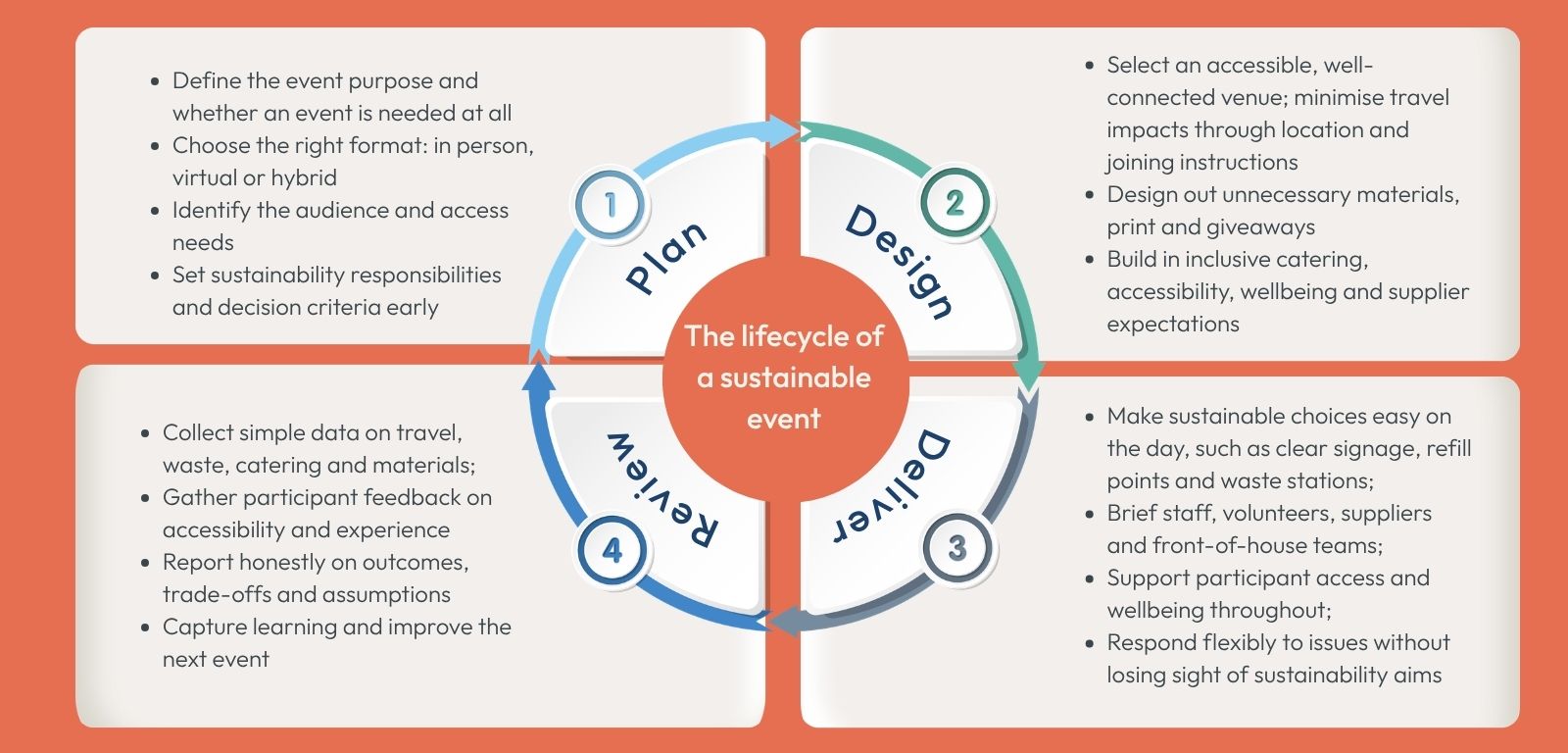
The guide follows the lifecycle of an event - Plan, Design, Deliver, Review - because that is where decisions are made and where impact can be shaped. You can follow it sequentially or dip into specific sections as needed. Early decisions, particularly around format, location and travel, tend to have the greatest effect; later sections focus on delivery and improvement.
Alongside the main guidance, two appendices provide practical tools to help organisers apply the principles in different contexts.
Appendix 1: Sustainability priorities by event type highlights the issues most likely to matter for different kinds of events, including conferences, research symposia, student summits, graduations, open days, exhibitions, career fairs and creative showcases. It can be used at the outset of planning to identify where effort is likely to have the greatest impact, highlighting where each has a natural sustainability advantage and where extra attention is usually needed.
Appendix 2: Sustainable events checklist provides a practical checklist aligned to the same Plan → Design → Deliver → Review lifecycle used throughout this guide. It can be used as a planning tool, a discussion aid with venues and suppliers, an on-the-day reference, or a prompt for post-event review and continuous improvement.
For many organisers, particularly those working under time pressure or organising events as only part of their role, the appendices may provide a useful starting point before exploring the more detailed guidance in the main document.
Visual 1: Event lifecycle diagram – a summary of key sustainability decisions at each stage
This guide was developed with support from the Scottish Funding Council and reflects a Scottish policy context. If you are based elsewhere in the UK or Ireland, the principles apply, but local policy, infrastructure and services may differ.
References to external organisations, tools, resources or examples are included to support learning and signposting. Their inclusion does not constitute endorsement by EAUC of any third-party product, service or content.
Continue to: What is a sustainable event?
Or jump to: Introduction | How to use this guide | What is a sustainable event? | Planning your event | Designing your event | Acknowledgements | More resources | Back to contents
3. What is a sustainable event?
In the context of post-16 education, a sustainable event goes beyond environmental considerations alone. It reflects a balance between environmental, social and organisational priorities, recognising that these are often interconnected.
Environmental sustainability includes reducing emissions, minimising waste and considering the impacts of procurement and resource use. Social sustainability relates to accessibility, inclusion, fair work practices and the wider experience of participants. Organisational sustainability includes governance, accountability, decision-making, risk management and alignment with institutional commitments and values.
A key principle underpinning this guide is proportionality. Not every event will be able to address every issue in depth. Institutions should focus on the actions that matter most for their specific event, based on its purpose, scale and context.
Where to start
If you are new to sustainable events, or working under time pressure, focus on these five actions first. They consistently deliver the greatest impact.
- Choose the right format. The single biggest sustainability decision is whether your event needs to be in person, virtual or hybrid. Make it a conscious choice, not a default. (See Section 4b.)
- Pick an accessible, well-connected venue. A venue on a good public transport network reduces car and air travel without placing additional burden on attendees. (See Section 5b.)
- Communicate travel options early and clearly. Detailed, practical information about how to get there by public transport significantly influences how people travel. (See Section 5h and Section 5i.)
- Eliminate single-use materials. Default to digital where possible; where physical materials are needed, choose reusable options. (See Section 5c.)
- Collect travel data. Ask attendees how they travelled. It takes minutes to add to a registration form and gives you the insight to improve next time. (See Section 7a.)
These five steps do not require additional budget or specialist expertise. They are a sound foundation on which everything else builds.
For a quick overview of the actions most relevant to different event types, see Appendix 1. For a practical summary of the actions covered throughout the guide, see Appendix 2: Sustainable Events Checklist.
4. Planning your event
Planning is where the foundation for a sustainable event is established. Decisions taken at this stage shape what is possible later on. In particular, choices about why the event is being held, who is expected to attend and how it will be delivered will determine much of its overall impact.
Organisers may also find it helpful to review Appendix 1 before beginning detailed planning, as different event types tend to face different sustainability priorities and constraints.
4a. Setting purpose and outcomes
A clear understanding of purpose is essential. Organisers should begin by asking what the event is trying to achieve and whether it needs to take the form initially envisaged. Not all content requires a physical gathering, and not all audiences need the same level of participation.
Linking the event to institutional priorities provides a useful framework. This includes, for example, climate strategies, sustainability commitments, equality and inclusion objectives, or wider civic responsibilities. When sustainability is considered at this stage, it becomes part of the event’s purpose rather than an add-on later.
For conferences, student-led events or and research-related events, this consideration may begin even earlier, at the point of developing a bid or funding application. Decisions about format, location and frequency are often embedded in proposals before an event is confirmed and can be difficult to revisit later. Supporting students and academic colleagues to consider sustainability at this stage can significantly influence outcomes. Organisers should also consider whether it could contribute to wider institutional priorities such as student employability, curriculum delivery, research, civic engagement or sustainability objectives.
This approach also aligns with wider sector developments, including commitments to the Concordat for the Environmental Sustainability of Research and Innovation Practice, which emphasise the need to embed environmental sustainability into research activities, including events and conferences, from the outset.
Events do not exist in isolation. In some cases, the greatest impact of an event may come not from the event itself, but from the ideas, behaviours and collaborations it enables afterwards. For example, events can be used to share sustainable practice, showcase innovation, support peer learning and encourage participants to adopt new approaches in their own institutions or workplaces. Where this wider influence is an intended outcome, it should be considered explicitly during planning and evaluation.
4b. Choosing the event format
One of the most significant decisions is whether the event should be delivered in person, virtually, or through a hybrid model. This choice has implications for environmental impact, accessibility, cost and experience.
Travel is often the largest contributor to an event’s carbon footprint. Reducing the need for long-distance travel will therefore have a substantial effect. EAUC has a number of tools available to institutions to support these decisions, including a digital decision-making tool for academic travel and business travel guidance.
These tools help organisers consider whether travel is necessary, whether alternatives are available, and what the implications might be for participants.
However, reducing travel is not always straightforward. In-person events can enable forms of engagement that are difficult to replicate online. They can support relationship-building, informal learning and a sense of community. Virtual and hybrid events, while more accessible in some respects, may create barriers for others or lead to lower levels of interaction.
The decision therefore requires careful consideration of what matters most in each context. There is no single correct answer, but there should always be a conscious choice. Carbon impact is important, but it should not be the only factor. Institutions should also consider the type of interaction required, the sensitivity or complexity of the topic, the wellbeing needs of participants, and whether the event is intended to build trust, confidence, collaboration or emotional support.
Some of the benefits of an event are much harder to measure than its carbon footprint. Improved decision-making, stronger relationships, better wellbeing, greater confidence, innovation, professional support and longer-term changes in practice may all be significant outcomes. These should be considered alongside environmental impacts, even where they cannot be reduced to a single metric.
Trade-off: In-person vs virtual vs hybrid
In-person events support relationship-building, informal learning, emotional connection and a sense of community that are difficult to replicate online. They may be particularly valuable where the event involves sensitive or challenging topics, complex discussion, innovation, relationship-building, or the professional and social support that comes from being in a room with peers.
Virtual formats reduce emissions substantially and can widen access, particularly for participants who face financial, geographic or physical barriers to attending in person. However, they create different challenges: lower engagement, screen fatigue, and fewer opportunities for the informal interaction.
Hybrid delivery can combine some of the advantages of in-person and virtual events. It can extend participation, reduce travel requirements, and provide access to speakers and audiences who may not otherwise be able to attend. However, hybrid events can also create challenges. They often require additional technical infrastructure, can increase costs, and risk creating different experiences for in-person and virtual participants. Successful hybrid events are typically designed specifically for hybrid delivery rather than treating online participation as an afterthought.
Neither format is inherently correct. What matters is making the choice deliberately, based on the purpose of the event and the needs of your audience, and being able to explain that choice.
4c. When to hold your event
Institutions should also consider the timing of events in relation to major religious observances, cultural events and academic calendars. Scheduling conflicts with other sector or institutional events can unintentionally exclude participants or limit attendance. On the flipside, institutions may also wish to consider whether events can be aligned with existing campaigns, awareness days or sector activity. This can help maximise engagement, reduce duplication of effort and create opportunities for collaboration. Examples might include World Environment Day, Fairtrade Fortnight, Colleges Week, Student Volunteering Week or local sustainability festivals. See the EAUC events calendar to find out more about what’s coming up.
Institutions should also consider seasonal and climate-related risks when choosing event dates and locations. Extreme weather, including storms, flooding, high winds and heat, can affect participant safety, travel reliability, venue comfort and accessibility. This is particularly important as climate impacts intensify and weather patterns become less predictable across the UK and Ireland.
Taking these factors into account at an early stage can support more inclusive participation.
Quick win: Check the calendar before confirming a date
Before setting an event date, check it against major religious observances, school and university term dates, national holidays, and known sector conferences. This takes around fifteen minutes and can prevent inadvertently excluding significant portions of your audience. EAUC's events calendar [link] can help identify clashes with sector activity.
4d. Governance and accountability
Responsibility for sustainability should be clearly defined as part of the planning process. This does not necessarily require a dedicated sustainability lead, but there should be clarity about who is considering key issues and how decisions are being made.
Events rarely sit outside wider institutional priorities. Sustainable events are most effective when supported by wider institutional leadership and aligned with strategic priorities, recognising that sustainability is increasingly relevant to organisational resilience, risk management, research, teaching and community engagement.
They form part of how institutions operate, and their impacts contribute directly to areas such as carbon emissions, resource use, procurement, accessibility and wellbeing.
Where possible, events should be aligned with institutional sustainability strategies and reporting frameworks from the outset. This includes considering how the event contributes to:
- institutional net zero or carbon reduction targets
- Scope 3 carbon emissions reporting, particularly travel, procurement and catering
- sustainability and/or environmental reporting requirements
- equality, diversity and inclusion objectives
- civic and community engagement commitments
- external frameworks and commitments such as the Concordat for the Environmental Sustainability of Research and Innovation Practice.
This does not require complex reporting for every event, but it does mean recognising that events are part of the system being measured.
4e. Budget and resourcing
Financial considerations are an integral part of planning and can significantly influence sustainability outcomes. It is important to recognise that lower-cost decisions are not always lower-impact. Equally, more sustainable options do not always require additional expenditure and can sometimes reduce costs over time.
Thinking in terms of whole-life costs is a more accurate basis for decision-making. Investing in reusable materials can be more cost-effective than repeatedly purchasing single-use items. Similarly, reducing waste or travel can lead to savings as well as environmental benefits.
Balancing budget constraints with sustainability ambitions is often one of the most practical challenges institutions face. Being transparent about these constraints, and making considered decisions within them, is key.
Watch out: "Eco" labelling is not the same as lower impact
Products marketed as sustainable, ethical or eco-friendly are not always the lower-impact choice. A branded tote bag described as organic cotton may have a higher carbon footprint than a cheaper alternative if it is not used regularly. A catering supplier with "green" credentials may still rely on heavily processed, long-supply-chain ingredients.
Look beyond labels and ask for evidence. What matters is the actual impact of a product or service across its full life, not how it is marketed.
4f. Ethical considerations and partnerships
Many events involve external partners, sponsors or contributors. These relationships can bring significant value but may also raise ethical and reputational questions.
Institutions should consider whether potential partners align with their values and commitments. This may include reflecting on relationships with high-emission industries or organisations whose activities do not align with institutional sustainability goals.
Recent sector discussions, such as those reflected in the University of Cambridge’s “grace” on fossil fuel industry ties, highlight the importance of this issue. While approaches will differ across institutions, it is important that decisions are made consciously and that any risks are understood.
In some parts of the sector, questions around sponsorship and partnerships are not only institutional considerations but are also being actively raised by students and staff. This is particularly visible in areas such as careers fairs and recruitment events, where the presence of certain industries or organisations can generate debate about alignment with institutional values and climate commitments. Student network People and Planet have a live Fossil Free Careers campaign.
This landscape is evolving, and expectations may differ between institutions. Some have introduced formal positions or restrictions, while others are still exploring how to approach these questions. Being aware of these dynamics, and engaging with them openly, can help institutions make more informed and transparent decisions.
Watch out: Misaligned sponsorship creates reputational risk
Accepting sponsorship from organisations whose activities conflict with institutional sustainability commitments can create significant reputational risk - particularly for public-facing events or those attended by students. This is an area where sector expectations are evolving quickly.
Establishing a clear internal policy on partnership and sponsorship before a specific case arises is far easier than making the decision reactively under time pressure. The University of Cambridge's debate on fossil fuel industry ties provides a useful reference point for the questions institutions are increasingly being asked to address.
Alongside managing risk, there is also an opportunity to take a positive approach to partnerships. Events can be used to showcase values-aligned organisations, support local suppliers or social enterprises, and create opportunities for collaboration that reflect institutional priorities.
Setting clear sustainability objectives at the outset, alongside the overall aims of the event, can help guide decision-making throughout the process. This includes clarifying roles and responsibilities across organisers, suppliers, venue teams and volunteers, ensuring that sustainability expectations are understood from the beginning.
Communication is particularly important. Sustainability intentions should be shared early and consistently with speakers, delegates, exhibitors and partners. This helps set expectations, reduces confusion later on, and enables others to contribute to the overall aims of the event.
4g. Embedding sustainability into the programme
Sustainability can be reflected not only in how an event is delivered, but also in what participants experience and learn. Depending on the purpose of the event, institutions may wish to include opportunities for attendees to explore sustainability-related themes, use transformative pedagogies and facilitation methods, share examples of effective practice, or contribute ideas for future improvement. This can help extend the impact of the event beyond its immediate objectives.
5. Designing your event
Once the overall approach has been established, attention turns to the detail of how the event will be delivered. This is where many practical decisions are made, shaping both the participant experience and the overall impact.
5a. Travel and location
The choice of location plays a central role in shaping how participants travel. Selecting a venue that is well connected to public transport significantly reduces reliance on private vehicles or air travel. In some cases, choosing a different location, or offering multiple access points, reduces emissions and improves accessibility.
Event schedules can influence travel behaviour. Start and finish times should take account of public transport timetables and realistic journey times. Scheduling an event too early or too late may unintentionally encourage car travel or overnight stays that could otherwise have been avoided.
Weather and climate conditions should also be considered as part of travel planning. Extreme heat, storms or flooding can disrupt rail, road and active travel routes, and may affect participants’ ability to travel safely. This is particularly important for events where attendees are travelling long distances or where alternative routes are limited.
Watch out: Extreme weather can disrupt sustainable travel plans
Recent sector events have shown how high temperatures and extreme weather can affect travel, comfort and safety. At EAUC’s annual conference in Swansea, temperatures approached 40°C, creating additional pressures for delegates, organisers, venues and transport systems.
When planning events, consider contingency arrangements for extreme weather. This may include flexible arrival times, clear travel updates, shaded or cool spaces, additional water access, adjusted agendas, hybrid options for those unable to travel, and clear communication about what participants should do if disruption occurs.
Some public transport providers are willing to provide discounted travel to delegates of major events – this can help provide an incentive to travel by public transport, and help individual and institutional finances.
Institutions should provide clear information about sustainable travel options including public transport, walking routes and cycling facilities. Where good alternatives exist, actively discouraging high-emission travel options is appropriate.
At the same time, access must remain a priority. Reducing travel should not unintentionally exclude participants or limit diversity of attendance. Hybrid approaches offer one way to balance these consideration, although they introduce additional complexity in delivery.
Clear, practical information can make a significant difference to how participants travel. Providing detailed directions, including step-by-step guidance from public transport hubs, photographs of key landmarks or entrances, and clear descriptions of the venue can encourage more sustainable travel choices. This is not only an environmental consideration but also an inclusion issue. Detailed directions can reduce stress and uncertainty for first-time visitors, international guests, neurodivergent attendees and anyone unfamiliar with the local area.
Quick win: Write a proper travel section in your joining instructions
Most joining instructions include a venue address and perhaps a postcode for sat nav. Go further: include step-by-step directions from the nearest train and bus stops, the names of the most relevant services, a photograph of the venue entrance, and an estimated walking time from public transport. Where cycling is viable, note the location of secure storage and shower facilities.
Where possible, provide visual information alongside written instructions. Annotated maps showing public transport stops, cycle storage, accessible entrances, parking and event registration points can make navigation significantly easier. If your institution has a digital campus map, consider linking directly to relevant locations.
You may wish to facilitate car sharing between participants travelling from similar locations – this has served EAUC well when strikes and extreme weather have affected public transport availability.
This single addition, which takes around thirty minutes to write, consistently influences how people choose to travel.
At the same time, it is important to recognise that some participants will need to travel by car, for example due to accessibility requirements or transport limitations. Ensuring that these needs are accommodated is an essential part of inclusive event design.
Personal safety can also influence how people travel to and from events. Some participants may feel unsafe travelling alone, using unfamiliar public transport routes, or travelling after dark. Where appropriate, organisers should consider practical measures that support safer participation, such as scheduling events to align with daylight or public transport availability, facilitating travel buddy arrangements, sharing safe travel information in advance, or signposting local taxi options. These considerations can support both inclusion and wellbeing.
Trade-off: Reducing travel vs maintaining access
Discouraging high-emission travel is a legitimate sustainability objective, but it can unintentionally disadvantage participants who depend on those options. This includes people with disabilities or caring responsibilities, those travelling from areas with limited public transport, and attendees for whom sharing a car is actually the most affordable option.
Prioritise clear information and genuine alternatives before discouragement. If a venue is genuinely difficult to reach without a car, acknowledge this honestly and ask whether it is the right venue for your audience and purpose.
5b. Venues
When selecting a venue, institutions should look beyond headline credentials and consider how the space operates in practice. This includes both environmental performance and the experience it provides for participants.
Key considerations include how energy is managed (for example lighting and heating controls), whether the building has recognised sustainability features such as efficient design or on-site renewables, and how waste is handled within event spaces. Practical details, such as whether recycling facilities are easily accessible in rooms, or whether single-use items are routinely provided, can have a significant impact on outcomes.
It may also be helpful to understand whether the venue has recognised environmental credentials such as BREEAM, Passivhaus certification, renewable energy generation or net-zero operational commitments. While no accreditation guarantees sustainability performance, these can provide useful indicators when comparing venues.
Accessibility, welfare and safety are equally important. This includes the availability of appropriate facilities, quiet or breakout spaces, and infrastructure to support hybrid delivery where required, such as built-in microphones or audio-visual systems.
Room layout can influence participation. Depending on the purpose of the event, formats such as cabaret-style seating, round tables, workshops and facilitated small-group discussion may encourage greater interaction than traditional lecture-style layouts. The most effective approach will depend on the audience, objectives and accessibility requirements of the event.
Catering considerations should form part of venue discussions from the outset. For example, institutions may wish to understand whether venues can support plant-rich menus, accommodate a wide range of dietary requirements, minimise packaging and align with broader sustainability objectives. Again, we recommend EAUC’s forthcoming sustainable catering guide for a deeper dive into these issues.
Where appropriate, consider whether outdoor space or connection to nature can form part of the event experience. This might include walking discussions, outdoor breaks, campus or community tours, nature-based wellbeing activities, or simply access to green space between sessions. Outdoor elements should be optional, accessible and weather-aware, with alternatives available so that they support inclusion rather than creating new barriers.
Contracts and agreements play an important role. Setting clear minimum expectations with venues ensures alignment with sustainability objectives and reduce the need for reactive changes later.
Ask your venue
Use these questions early in the selection process, before, not after, a contract is signed.
Energy and environment
- What sustainable building standards, if any, does your venue comply with?
- How is energy managed in event spaces? Can lighting, heating and ventilation be adjusted for your specific hours of use?
- Does the building use renewable energy, and if so, what proportion of its energy does this cover?
- Does the venue hold environmental certification (e.g. Green Tourism, ISO 14001)? What does this cover in practice?
- Can you provide information on indoor environmental quality, including ventilation arrangements and, where available, monitoring of factors such as CO₂ levels, temperature and occupant comfort?
Waste
- Are clearly labelled recycling and composting facilities available within or immediately adjacent to event rooms?
- What is the venue's default approach to single-use items such as bottled water, notepads and pens. Can these be removed from your package?
- Does the venue have a food waste redistribution arrangement?
Accessibility and welfare
- Is the venue fully step-free, and does this extend to all spaces you intend to use?
- Are hearing loops available and regularly maintained?
- Are there quiet or breakout spaces, prayer or reflection rooms, and private facilities such as breastfeeding provision?
Hybrid and AV
- Does the venue have built-in microphone and audio-visual infrastructure for hybrid delivery?
- Is AV equipment LED-based, and what is the venue's policy on powering down equipment between sessions?
Watch out: Certification doesn't tell you everything
A venue with a recognised environmental certification has met a defined set of criteria, but certification schemes vary in scope and rigour, and even well-certified venues can fall short in specific areas. A venue certified for energy management or with a sustainable catering kitemark may still supply single-use plastics as standard, or have poor waste infrastructure within event rooms.
Treat certification as a useful starting signal, not a final answer. The questions above will tell you more than any badge.
Find out more about certification in Section 8.
- Materials, waste and circularity
Events can generate significant amounts of waste, particularly through printed materials, packaging and short-lived items. A shift towards a more circular approach can help reduce this impact.
The most effective strategy is to avoid unnecessary materials in the first place. This reflects a broader principle of sustainable event design: preventing impacts where possible is generally more effective than managing them after they have occurred. Where materials are needed, designing them for circularity or reuse can extend their life and reduce waste. Recycling remains important but should be seen as a last step rather than the primary solution.
Visual 2: simple waste hierarchy diagram
Watch out: Recycling is not a sustainability strategy
It is easy to feel that an event has handled its waste well because recycling bins are provided. But the environmental cost of producing, transporting and processing materials is not eliminated by recycling - it is only partially reduced. An event that generates large volumes of waste and recycles most of it can have a high negative impact.
The priority order is: avoid producing the item in the first place; reduce what cannot be avoided; reuse wherever possible; and recycle as a last resort. This should also be part of your expectation setting with suppliers and partners.
Digital approaches can support reductions in physical materials, but they also have their own environmental impacts, including energy use and data infrastructure. Institutions should consider the broader implications of digital delivery, including guidance on digital sustainability and responsible use of technologies such as AI.
Quick win: Audit your default print run
Most events carry over the same printed materials year on year without reviewing whether they are still needed, whether quantities are right, or whether a digital alternative would work as well. Before your next event, list every item you plan to print and ask three questions: Do attendees actually use this? Could it be replaced by a QR code or digital download? What would happen if we printed half as many?
In most cases, print volumes can be reduced significantly without any negative effect on the event experience.
Where printing is necessary, consider how materials are produced as well as how much is printed. Recycled or FSC-certified paper, vegetable-based inks and local print suppliers may help reduce impacts.
Where physical materials are used, the distinction between reusable and disposable items is particularly important. Reusable options are generally preferable, but only where systems are in place to manage them effectively. Similarly, decisions about merchandise or promotional items should be approached with caution. Items that are not useful or durable are likely to become waste quickly, regardless of how they are marketed. This is something to work on together with your suppliers. You might also want to join a local or national re-use scheme such as Warp It or My Uni Green Scheme.
Design choices extend the life of materials. For example, avoiding event-specific dates or branding can allow signage and materials to be reused across multiple events.
Trade-off: Reusable crockery vs single-use compostables
Reusable crockery, glasses and cutlery are usually the better option than single-use items, even when those items are labelled compostable or biodegradable. Reuse avoids the repeated production, transport and disposal of materials, and helps normalise a lower-waste event experience.
However, reusables only work well when the right systems are in place. They need to be collected, washed, stored and returned, which may involve cost, staff time, water, energy and logistics. For some venues or off-site events, this may be difficult to manage safely and efficiently.
Compostable single-use items can be useful where reuse is genuinely not practical, but they are not impact-free. They still require resources to produce and often only compost properly in specific commercial systems. If they end up in general waste, recycling, or the wrong composting stream, much of the intended benefit is lost.
The aim should be to default to reuse wherever the infrastructure exists, and to treat compostable disposables as a fallback option rather than a sustainable default. When single-use items are unavoidable, confirm how they will be collected and processed before the event.
Materials, waste and circularity is a substantial topic in its own right, and this section only introduces the key considerations for event planning. For more detailed guidance on applying circular economy principles across institutional operations, procurement and resource use, see EAUC’s Circular Economy Guide.
Quick win: Design for reuse from the start
Avoid printing dates, years, conference titles or event-specific branding onto banners, exhibition materials and signage unless absolutely necessary. Generic, modular designs can often be reused across multiple events, reducing waste, procurement costs and storage requirements. When designing new materials, ask whether they will still be useful in three years' time.
| 15 July 2026 | |
| Resource | |
| EAUC |