
Education for Sustainable Development
Education for Sustainable Development (ESD) or Learning for Sustainability (LfS) is an approach to teaching that equips students with the knowledge, skills and values to shape a fairer, greener future.
To support practitioners to embed ESD in learning and teaching, EAUC runs a community of practice, as well as creating resources and hosting events.
On this page, we share a learning pathway to successfully embed ESD in your practice, as well as a summary of its key drivers.
Introducing the learning pathway
Initially developed as part of our guidance on Learning for Sustainability in colleges, the learning pathway is designed to support practitioners on every step of their ESD journey. At each stage, you’ll find an overview of what people typically are looking for, a few "quick wins" and a handful of key resources.
Get in touch to help develop the pathway further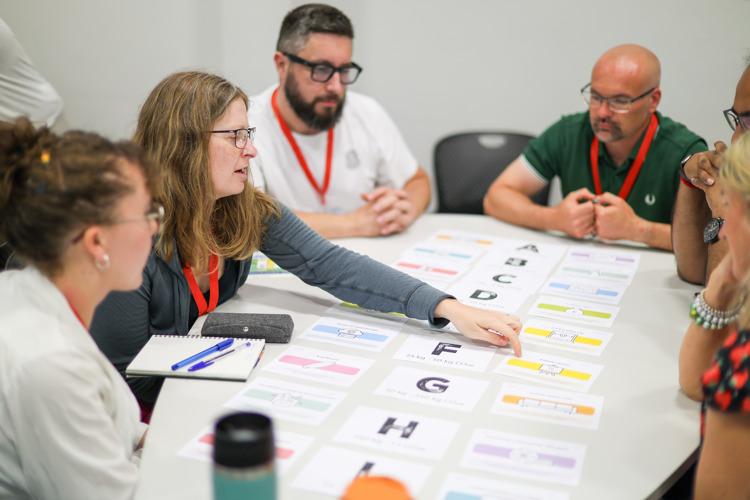 EAUC / Fine Time Photography
A learning pathway to successfully embed ESD
About you
You are looking to increase your understanding of how sustainability relates to education. You might have been inspired by a personal or professional interest, external prompts (e.g. requirements in unit specifications or quality assurance) or, for example, a growing awareness of resource use (energy, water, materials, etc) and its impacts on people and planet.
Quick wins and starting points
Talk with students and colleagues about sustainability. What social, environmental or economic issues do they care about? Are colleagues aware of LfS being part of higher national qualifications, or in the QAA quality code? Do you have a colleague or student who is knowledgeable about a particular sustainability issue?
Resources
Watch this 3-minute video from UCLA explaining sustainability and why interconnectedness matters
The EAUC Sustainability Champions learning pack supports staff and students in tertiary education institutions to improve their understanding of core sustainability topics
The SQA Academy module on LfS is a quick introductory course
Learning for a Sustainable Future and Embedding ESD in FE and Skills are online, self-guided courses for a deeper dive
About you
You are looking to explore your existing practice and find out how you’re already addressing sustainability. You also want to celebrate how much there already is that helps to contribute to a better future for our learners.
Quick wins and starting points
Look at the Sustainable Development Goals or another sustainability framework. Which Goals are you, your colleagues or your institution already addressing? Is this being made visible? Is this celebrated? What are plans to further build on this?
Resources
SDG mapping tools from Education and Training Foundation and University of Cork
The Green Gown Awards recognise multiple categories of sustainability practice, while the CDN Awards and AoC awards also have sustainability categories – apply to celebrate your work with others in the sector
Share your work with the EAUC - through this form or by emailing kmobius@eauc.org.uk - and you could be published as part of resources or invited to speak at events
About you
You are looking to move from noticing to designing, explicitly linking to and integrating sustainability (e.g. by referencing sustainability in learning activities and learning outcomes).
Quick wins and starting points
Looking at any maps or reflections you have created previously – what are you not yet addressing? Is there a balance between social, environmental and economic issues? Embed an activity or project with your learners that helps them explore how sustainability matters to them - for example, by discussing the SDGs or local news about sustainability-related issues and opportunities.
Resources
Education & Training Foundation’s subject specialism guide provides examples of sustainability content for every subject area
UNESCO Greening curriculum guidance provides useful learning objectives per topic and age group
QAA and Advance HE guidance on ESD is comprehensive and particularly relevant for HE courses
About you
You want to explore pedagogies and teaching methods that support learners to develop skills, values, agency and knowledge through engagement with sustainability, as well as supporting student engagement and wellbeing.
Quick wins and starting points
Read up on a sustainability competency framework and reflect how you are currently addressing these and where gaps are. Get learner feedback on how they feel they are developing sustainability competencies and which learning experiences have stuck with them. Speak to your manager about undertaking training on teaching methods that support sustainability.
Resources
CoDesignS AI coach supports you to develop learning methods and activities with ESD learning objectives embedded, while also teaching you to prompt (requires a ChatGPT account to work)
Rounder Sense of Purpose shares examples of teaching activities aligned to the SDGs and sustainability competencies
Explore competency frameworks such as Aim Hi Green skills, UNESCO ESD competencies and the Inner Development Goals
Understanding what makes sustainability education effective is an academic paper that includes a review of pedagogical approaches
About you
You want to support learners to shape the institution. You understand that learning is more relevant and meaningful when learners have a say in it, while also feeling safe and supported by teaching staff.
Quick wins and starting points
Allow space for your learners to decide on an issue they want to explore. Ask your manager, leadership, or the sustainability committee at your college about how they’re including the student voice in their work. Advocate for the inclusion of sustainability questions in student surveys or to run the annual UK-wide Sustainability Skills Survey.
Resources
University of Edinburgh’s top tips and introductory activities for co-creation provides a list of starting points for learner-led approaches
Sparqs Student Learning Experience model and its Sustainable Development lens can form a base for student engagement
Students Organising for Sustainability (SOS UK), Force of Nature and 2050 Climate Group are organisations supporting students and young people to develop sustainability skills and leadership
Learning, Leading, and Letting Go of Control is an academic paper discussing learner-led approaches
About you
You want to increase the relevance of sustainability to learners, engaging them in real-world, experiential learning that supports employability. You want to create an antidote to hopelessness and apathy by supporting and agency and action.
Quick wins and starting points
Ask learners who they think is responsible for issues like climate change or inequality and what this means for their own and others’ actions. Meet with (or invite as guest speakers) employers or organisations and ask them how learning projects can support their sustainability work. Work with learners, their families and friends, colleagues and/or employers to pledge a sustainability action and review what has happened later in the year.
Resources
SHIFT’s "Find my Superpowers" quiz supports you to take sustainability action as a citizen, professional, consumer, investor or role model
ClimateCulture provides a list of national and international organisations working on interconnected sustainability issues, including equality, fashion, food, communications, etc.
Beyond the bottom line: overcoming SDG myopia in work-based learning includes a chapter on connecting work-based learning and the SDGs in meaningful ways
About you
You are looking to develop LfS as not just an add-on, but an integrated part of units, courses, and the overall learning experience.
Quick wins and starting points
For project briefs, ask students to map their project against the SDGs and why the impacts of their work on people and planet matter. For assignments and exams, include a (reflective) question about sustainability. When supporting existing or new projects, encourage students to ask questions to each other, organisations, employers or communities about sustainability and how the projects support this.
Resources
Transforming Futures UNESCO project includes a strand on assessment of learning for the SDGs
UNESCO's guide to design and try out assessment of significant learning in ESD provides reflective activities, action prompts (p. 11 and 20) and examples of suitable assessment types (p. 33)
Innovating Assessment for ESD is an open access book chapter summarising recent research and assessment design principles for ESD
Assessment as learning is an academic article on assessment as learning, exploring how assessment can support, not only test, learning
About you
You want to connect and collaborate on sustainability projects with people from different roles across the college and/or with communities and employers.
Quick wins and starting points
Find out who at your college works on sustainability projects, ask what they are doing, and explore how you and your learners can support this in mutually beneficial ways; do an "SDG walk" with students and ask them to identify how the physical and digital campus addresses the SDGs – then share this with others such as your manager or marketing staff; map which communities or employers you are already collaborating with and who you can still reach out to.
Resources
The Climate Action Roadmap for FE colleges provides a set of actions colleges can take as part of a whole institution approach
University of Sheffield’s Five Step Framework supports embedding ESD across an institution
Wicked collaboration: How do we collaborate well is a short blog post laying out helpful prompts for reflection and discussion in collaborations
Systematic review of whole institution approaches is an academic paper outlining what effective whole institution approaches look like
About you
You are looking to evaluate, increase and share the impact of your work, advocating for system changes across and beyond the institution.
Quick wins and starting points
Form or strengthen one internal or external partnership to tackle a systems challenge; publish or present a short case study about your LfS work with the EAUC or at a college event; engage with Learning for Sustainability Scotland to respond to a consultation by an educational or governmental body.
Resources
Subscribe to the bulletin and policy & research updates from Learning for Sustainability Scotland to hear about opportunities and consultations to support systems change in Scotland
Monitoring and Evaluating ESD in higher education is a framework and handbook to support evaluating ESD through a learning spiral
Green Changemakers: Community is Everything is an FE News article discussing different kinds of "power" for creating systems change as a community
About you
You want to both draw and critically reflect on a range of different frameworks and concepts, and continue learning.
Quick wins and starting points
Read up about or join an event on another framework or way of addressing sustainability and compare it to what you know; ask questions about the strengths and weaknesses of LfS as a framework to other practitioners; critique the SDGs with students; explore decolonisation of the curriculum.
Resources
Doughnut Economics, Peace Education, Global Citizenship Education and Critical Pedagogy are alternative sustainability and education frameworks
Decolonising the Curriculum is a toolkit from Manchester Metropolitan University that supports practitioners to embrace knowledge systems outside of typical western understandings
This THE blog on Critical approaches to incorporating the SDGs into curricula highlights the shortcomings of the SDGs and how to overcome them
About you
You want to embed fun, lightness and playfulness into your work on sustainability, and use methods and materials that engage people without "doom and gloom".
Quick wins and starting points
Play "sustainability bingo" in class – create a bingo card with social, environmental and economic sustainability actions, e.g. taking public transport to buying reused clothing, and ask students to talk to each other to get a row or column. Create a positive atmosphere where people can share what excites them. Play a game or ask learners to set up a quiz - for example, via Kahoot.
Resources:
Climate change: Earth's giant game of Tetris is a TEDx video explaining the role of carbon playfully
Climate Science Breakthrough breaks down sustainability issues into every day language, delivered by UK comedians, while Serious People run satirical campaigns raising awareness for justice issues such as tax-free fuel for private jets
This blueprint by Ingenium helps you to organise an escape room on sustainability topics
AWorld is a gamified platform designed to track and encourage sustainable daily habits
There are many other ways of approaching this – what’s yours?
Drivers of ESD and LfS in post-16 education
This overview summarises some of the key policies and other requirements driving Education for Sustainable Development and Learning for Sustainability. It was initially developed for a Scottish college context, but we are looking to broaden the scope. Get in touch if you’d like to get involved in developing this resource further.
In Scotland, LfS is an entitlement under the 3-18 curriculum, and progress on this is driven by the Scottish Government’s LfS Action Plan. This means that learners bring with them informed questions, values, and expectations about sustainability.
Scottish policies and UK-wide standards for further and higher education make these expectations explicit. They both signal a clear direction of travel for colleges and provide useful reference points for developing LfS in practice:
The Professional Standards for College Lecturers, which include two standards on sustainability (Standard 1.2.5 and 2.3.5) – however, LfS is a useful lens through which to reflect on all professional values.
The Scottish Funding Council’s (SFC) Outcomes Framework and Assurance Model, where both net zero and equality, diversity and inclusion (EDI) – two key aspects of LfS – are cross-cutting themes.
The UK Quality Code, an important external framework for colleges through the Externality principle of the Tertiary Quality Enhancement Framework. Updated in 2024, it makes explicit reference to sustainability in teaching.
The sparqs Student Learning Experience model, used to evaluate the student learning experience, has sustainable development as one of three lenses.
Higher national qualifications by Qualifications Scotland, where LfS is a key aspect and mandatory part of the renewed Higher National qualifications (commonly known as NextGen HN)
The Scottish Apprenticeship Advisory Board’s recommendations on how sustainability should and can be included within apprenticeships.
Skills Development Scotland’s commitment to influencing the skills system to be responsive to the climate emergency, and to embed sustainability into learning provision.
The Climate Change (Scotland) Act 2009, where, alongside requirements to set targets and reduce environmental impact of operations, sustainability education is a core component of colleges evidencing meeting of their statutory duties.
In Scotland, one of the main policy drivers for environmental sustainability in education institutions is the statutory guidance for public bodies on the climate change duties (PBCCD). It sets out key values and expectations for public bodies, including colleges and universities, which include links to teaching and whole institution approaches:
Embedding sustainability throughout all the college’s core functions (including teaching)
That the college proactively creates and enables an environment which supports the above actions (i.e. role of leadership and governance, staff training, use of sustainability impact assessments in decision-making, etc)
People at colleges and universities responsible for PBCCD reporting will be interested in how the curriculum can support sustainability too.
The knowledge, skills, values, and agency that LfS can enhance and develop will support a greener and fairer economy – and many employers recognise this. As a result, demand for the competencies LfS develops has risen – not only for "green", environmental jobs, but for a variety of jobs and roles. Most practitioners are aware that roles require social skills and technical knowledge, but some may ask the question: "why do my students need environmental knowledge and skills?"
Green skills are in high demand
LinkedIn Global Green Skills report, 2025: demand for green skills is growing twice as fast as supply
edie article summarising trends, 2025: over a quarter of employers are already reporting skills shortages in sustainability-related roles
All roles are greening
The jobs where "green skills" are most needed are often not those we would typically think of as "green".
Lightcast, The UK Skills Revolution, 2025: project management roles, for example, featured green skills most often in job postings
LinkedIn, Global Green Skills report, 2025: more than half of green hires now sit in non-green job titles, including roles in operations, procurement, technology, media, finance and education
Careers and student support staff should be aware of these developments. Teaching staff can discuss the environmental aspects of future careers with students, and invite employers to speak about their sustainability and social responsibility efforts.
Still unsure about the term "green jobs"?
Have a look at the EAUC’s green career guides, which break green jobs down into simple terms and support students and staff to explore, find, and apply to green jobs.
Resources to support Education for Sustainable Development
Learn more
21 September 2026
|
Resource
By the sector, for the sector: the co-creative approach of the new Learning for Sustainability in colleges guide
Read More
7 September 2026
|
Resource
28 April 2026
|
Resource
27 January 2026
|
Resource
25 November 2025
|
Resource
Community of practice
The Education for Sustainable Development community of practice is a space to meet and exchange ideas with staff from other institutions who are also integrating sustainability into their teaching. The group is led by the EAUC, with support from our partners at Learning for Sustainability Scotland.
This group is open to EAUC education members and selected external organisations supporting ESD in post-16 education. While the community has a focus on learning and teaching, staff from estates, operations, leadership and other areas are also welcome to join the network.
Convenors
Lou Mycroft, Green Changemakers Facilitator, Fircroft College of Adult Education
Scott Strachan, Senior Teaching Fellow, Electronic and Electrical Engineering, University of Strathclyde
Rehema White, Senior Lecturer, School of Geography and Sustainable Development, University of St Andrews

ESD, LfS, green skills, or EfS?
There are many names and approaches that describe education aimed at building a fairer, more sustainable world. While each has its own nuances, we believe they share a common purpose - and that we are stronger together than apart.
We chose ESD as it is widely recognised in higher and further education across the UK and internationally, and is used by key sector bodies such as QAA. But our community is not prescriptive about frameworks. On the contrary - we very much welcome different perspectives and invite everyone to join us in learning from each other with openness and kindness.

Upcoming events
View all events21 January 2027, 12:30pm - 2pm
Online
Explore related pages